 .
.
|
Back to Home. |
|
| Author's Note The writing of the first Akitada novels actually predates the stories by more than a decade, but it was to be the stories that brought the novels into print. For this the credit goes to the late Cathleen Jordan, longtime editor of Alfred Hitchcock’s Mystery Magazine, because she took a chance on an unknown author with a strange subject and in 1997 accepted the first of the Akitada stories for publication. All subsequent stories went to her and none was rejected. The novel THE HELL SCREEN began as a story intended for Cathleen, and the story “The O-Bon Cat” caused the writing of the current Akitada novel. The novels and the stories are closely related, though story writing is a very different process that demands much more attention to plot than to character development or theme.
|
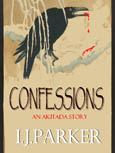 |
CONFESSIONS “Confessions” appeared
in Alfred Hitchcock’s Mystery Magazine November 2012. The story is based
on an ancient tale, “The Three Priests”, which has also been rewritten
by the famous Japanese author Akutagawa. In this version, Akitada clears
a “cold case” murder for which three persons bear responsibility. It is
a wintry tale. |
|
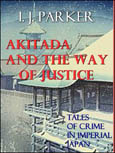
AKITADA AND THE WAY OF
JUSTICE A collection of eleven Akitada stories, arranged chronologically for his career, is now available as a Kindle Exclusive. Eleven stories, arranged chronologically, illustrate Akitada’s career. The cases are diverse, with clues ranging from moon cakes and Chinese lutes to feral cats and incense competitions. They have previously appeared in Alfred Hitchcock's Mystery magazine, and the first story won the Shamus Award. CONTENTS: “Akitada’s First Case”, “The Incense Murders”, “Rain at
Rashomon”, “Instruments of Murder”, “The Curio Dealer’s Wife”, “The Master
of Go”, “The New Year’s Gift”, “The O-bon Cat”, “Moon Cakes”, “The Tanabata
Magpie”, and “Welcoming the Paddy God.” |
 |
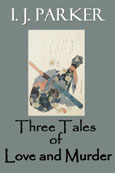 |
THREE TALES OF LOVE AND MURDER
“Death and Cherry Blossoms” (June 2002) - Sent to deliver marriage contracts to a nobleman’s villa outside the capital, young Akitada hopes for a pleasant outing among cherry blossoms, but finds a murdered bride, unrequited love, and shocking family secrets. “The Incense Murders” (September 2009) - In this story, a young Akitada is forced by his mother to visit a detested cousin where he uncovers an ingenious plot but ends up being charged with murder. “Instruments of Murder” (October 1997) - This is the first of the Akitada stories to appear in print and tells how Akitada is called away from his flute practice – much to the relief of his family – to rescue Tora who has been arrested for the murder of a wrestler. Akitada’s investigation takes him among ordinary people with extraordinary passions. |
| AKITADA'S HOLIDAY “The New Year’s Gift” (April 2001) - A former maid brings Akitada a small carved turtle as a New Year’s gift and begs him to help her husband who has been arrested for the murder of his adoptive father. He had a motive and was seen by a neighbor. Akitada discovers that others also had motives and left clues. One just had to look in the right places. “The O-Bon Cat” (February 2003) - On the eve of the festival that welcomes back the spirits of the dead, Akitada encounters a lost deaf-mute boy who reminds him of his little son who has died recently. The child briefly fills an emotional void for him but is taken away, leaving behind only the clue of a feral cat and an abandoned lakeside villa. Obsessed with the double loss, Akitada pursues the trail, and uncovers a tragic story of murder and abandonment. “The Tanabata Magpie” (September 2005) - A junior clerk in the Ministry of Justice is arrested for the murder of a wealthy man, whose daughter he has been courting. The case looks black against him. Akitada, who does not like the clerk, procrastinates, but the young man's suicide fills him with self-reproach and sends him belatedly on a complicated search for the real killer.
|
 |
| “The Curio
Dealer’s Wife”
(November 1997)
She is on tiptoe, trying to catch a glimpse of her children over the fence, when Akitada first sees her. Her strange tale about a man who, claiming to be her lost husband, has driven her out and taken over her family and her husband’s business causes Akitada to discover a vicious murder. |
 |
 |
“A Master of
Go”
(December 1998)
Akitada arrives for his lesson with a master of go and finds the police investigating his murder. None of the old man’s earlier visitors appears to have a motive. In a contest of wits with Kobe, the police captain, Akitada solves the crime by studying the game board and applying the go lessons learned from the master. |
 |
“Akitada’s
First Case” (July/August 1999)
Akitada, newly dismissed from his first job as a clerk in the Ministry of Justice, confides his troubles to a disappointed petitioner who hires him to find his missing daughter. His first investigation reveals that the young woman was murdered in the secret villa of a high-ranking nobleman and forces him to make a dangerous accusation. |
 |
|
|
“Rain At
Rashomon” (January 2000)
While waiting under the wide eaves of the city gate Rashomon during a heavy rain, Akitada, overhears two men discussing murder. A month later he recognizes one of the voices again during the murder trial of a poor vagrant. The voice, however, is not that of the accused, but of one of the constables. Akitada sets out to uncover a plot within a plot. |
|
“Welcoming
the Paddy God” (December 2001)
A middle-aged Akitada runs into his old friend Kobe, now Police Superintendent, who invites him to meet a monk who has confessed to an unspeakable rape-murder of a peasant girl. Though the prisoner appears depraved and repulsive, neither Kobe nor Akitada are quite satisfied. The subsequent investigation takes Akitada to a peasant village and a strange clue involving rice planting and the worship of the paddy god. |
|
 |
"The Kamo Horse"
(October 2003) Broke and in disgrace, Akitada ponders the inequities of fortune when Wataru, a handsome and wealthy young nobleman not only weds the most beautiful lady at court, but also wins the great Kamo race on the emperor's own horse. But the much beloved Lady Kesa is found murdered in her husband's bed and the "lucky" Wataru is the only suspect. Akitada uncovers a tragic web of court intrigue, broken promises, greed, and obsessive love. |
|
“Moon
Cakes” (January/February 2007)
When a hermit carrying an imperial heir’s compromising letter disappears in a famous temple, Akitada not only solves this case but also the apparent suicide of a monk and the strange behavior of the temple cat. |
|
 |
“The Water Sprite” (September
2011)
A maid has disappeared, and her parents want blood money from her employer. Akitada, much against his will, has been ordered to investigate rumors that a water sprite residing in a nearby pond is to blame. |
|
Sugawara Akitada, junior clerk in the Ministry of Justice, attempts in vain to convince his boss that a murder has occurred when the minister's neighbor claims a shape-shifting fox has attacked him. |
 |